
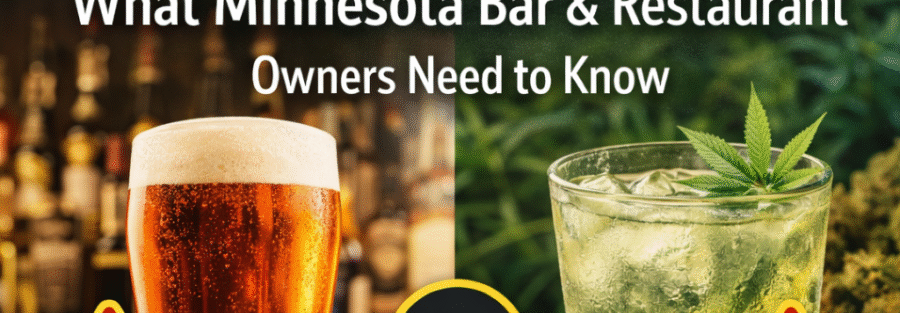
Liquor Liability vs THC Liability:
Minnesota’s hospitality industry is changing rapidly. With the introduction of THC-infused beverages and cannabis legalization, bar and restaurant owners now face a new and often misunderstood risk.
Does your insurance actually cover THC-related liability?
Many assume their liquor liability policy provides coverage. In reality, this is a risky assumption.
Below is an overview of the differences between liquor liability and THC liability in Minnesota, along with guidance on how to protect your business.
What Is Liquor Liability Insurance?
Liquor liability insurance is designed to protect your business if a customer:
- Becomes intoxicated
- Causes injury to themselves or others
- Causes property damage
In Minnesota, this is closely tied to dram shop laws, which can hold businesses responsible for overserving alcohol.
What Liquor Liability Typically Covers:
- Alcohol-related accidents
- Injuries caused by intoxicated patrons
- Legal defense costs
- Settlements and judgments
If you serve alcohol, liquor liability coverage is essential and often required.
Where the Problem Starts: THC Is NOT Alcohol
The critical issue is as follows:
THC is not alcohol, and most liquor liability policies treat it completely differently.
Although THC beverages may appear similar to alcoholic products, insurance carriers often:
- ❌ Exclude cannabis-related claims entirely
- ❌ Do not extend liquor liability to THC products
- ❌ Require separate underwriting or endorsements
What Is THC Liability?
THC liability refers to risks associated with:
- THC-infused beverages
- Edibles or infused products
- On-premises consumption
- Customer impairment from cannabis
Real-World Risk Example:
A customer consumes a THC beverage at your establishment, then:
- Drives and causes an accident.
- Injure themselves or others.
- Experiences an adverse reaction
If your policy excludes THC, your business may be fully exposed to liability.
The Biggest Insurance Gap in Minnesota Right Now
With Minnesota allowing hemp-derived THC products and expanding cannabis access, many bars and restaurants are:
✔️ Selling THC beverages
❌ But NOT properly insured for THC liability
❌ But NOT properly insured for THC liability
This results in a significant coverage gap.
Your liquor liability policy may cover alcohol-related claims, but deny those related to THC Liability.
| Covers alcohol claims | ✅ Yes | ❌ No |
| Covers THC products | ❌ Typically no | ✅ Yes (if added) |
| Required for alcohol service | ✅ Yes | ❌ Not always required (but critical) |
| Standard in most policies | ✅ Yes | ❌ Often excluded |
In summary, you likely need both types of coverage.
Common Mistakes Minnesota Business Owners Make
1. Assuming THC Is Covered Automatically
This is not the case. Most policies exclude cannabis unless specifically endorsed.
2. Not Disclosing THC Sales to Their Agent
If your agent is not informed, your policy may not accurately reflect your actual risk.
3. Buying Policies From Non-Specialists
Cannabis liability is complex, and many agents may not fully understand it.
4. Ignoring Product Liability Exposure
If you sell THC products, you may also require product liability coverage.
How to Properly Protect Your Bar or Restaurant
Here’s what smart Minnesota business owners are doing right now:
1. Review Their Current Liquor Liability Policy
Look specifically for:
- Cannabis exclusions
- Product limitations
- Coverage triggers
2. Add THC-Specific Coverage
This may include:
- Cannabis liability endorsements
- Product liability for infused beverages
- Completed operations coverage
3. Work With a Specialist
Not all insurance agents understand:
- Minnesota cannabis laws
- THC beverage regulations
- Carrier’s appetite for cannabis risks
Expertise is essential in these situations.
4. Evaluate Admitted vs Non-Admitted Carriers
Many THC policies are written through non-admitted carriers.
Pros:
- More flexibility
- Access to coverage
Cons:
- Less regulatory protection
- No state guarantee backing
It is important to understand these trade-offs.
Minnesota-Specific Considerations
If you own a bar or restaurant in:
- Minneapolis
- St. Paul
- Lakeville
- Rosemount
- Apple Valley
- Burnsville
- Eagan
- Or anywhere in Minnesota. You are operating within a rapidly changing regulatory environment.
Laws, enforcement, and insurance markets are still evolving.
As a result, your coverage should evolve as well.
The Bottom Line
Liquor liability protects you from alcohol-related risks.
It does NOT automatically protect you from THC-related risks.
If you serve or sell THC products—even occasionally—you need to:
✔️ Review your coverage
✔️ Identify exclusions
✔️ Add THC-specific protection
✔️ Identify exclusions
✔️ Add THC-specific protection
Otherwise, a single incident could result in significant financial loss. Get a Free THC & Liquor Liability Review Today
At Cannabis Insurance Cost, we specialize in:
✔️ Bar & restaurant insurance
✔️ Liquor liability coverage
✔️ THC & cannabis-related risks
✔️ Minnesota-specific compliance
✔️ Liquor liability coverage
✔️ THC & cannabis-related risks
✔️ Minnesota-specific compliance
We work with multiple top-rated carriers to develop policies that effectively protect your business.
👉 Call us today at 952-222-8073
👉 Or message us for a fast, no-obligation review
👉 Or message us for a fast, no-obligation review
Do not assume you are covered; ensure you have the appropriate protection.
Frequently Asked Questions
Q: Does liquor liability cover THC beverages in Minnesota?
A: Usually not. Most policies exclude cannabis-related claims unless specifically endorsed.
A: Usually not. Most policies exclude cannabis-related claims unless specifically endorsed.
Q: Is THC liability insurance required?
A: Not always legally required—but highly recommended if you sell or serve THC products.
A: Not always legally required—but highly recommended if you sell or serve THC products.
Q: Can I add THC coverage to my existing policy?
A: In many cases, yes—but it depends on the carrier. Some require separate policies.
A: In many cases, yes—but it depends on the carrier. Some require separate policies.
Q: What happens if I don’t have THC coverage?
A: You could be personally responsible for claims involving THC-related incidents.
A: You could be personally responsible for claims involving THC-related incidents.
Q: Are THC policies more expensive?
A: They can be—but the cost is small compared to the risk of being uninsured.
A: They can be—but the cost is small compared to the risk of being uninsured.